

Loading...
Loading...
Loading...



In a local area network, switches are very important hardware and help connect the peripheral devices effectively. These switches receive information from a source and forward it to the target device ensuring effective data transmission between the devices.
Basically network switches are classified as managed and unmanaged switches. Choosing between the two is critical while designing a network.
In this article we will discuss about network switches and the points to consider while selecting between managed and unmanaged switches.
Unmanaged switches are switches that use auto-negotiated ports to determine data rates and modes of transmission like Full Duplex or Half Duplex. They maintain MAC address tables, that track dynamically learned MAC addresses and corresponding port addresses.

Managed switches allow network administrators to configure switches, enabling them to manage and monitor the network better. Simple Network Management Protocol (SNMP) allows network administrators to monitor switch ports, traffic throughput and errors.
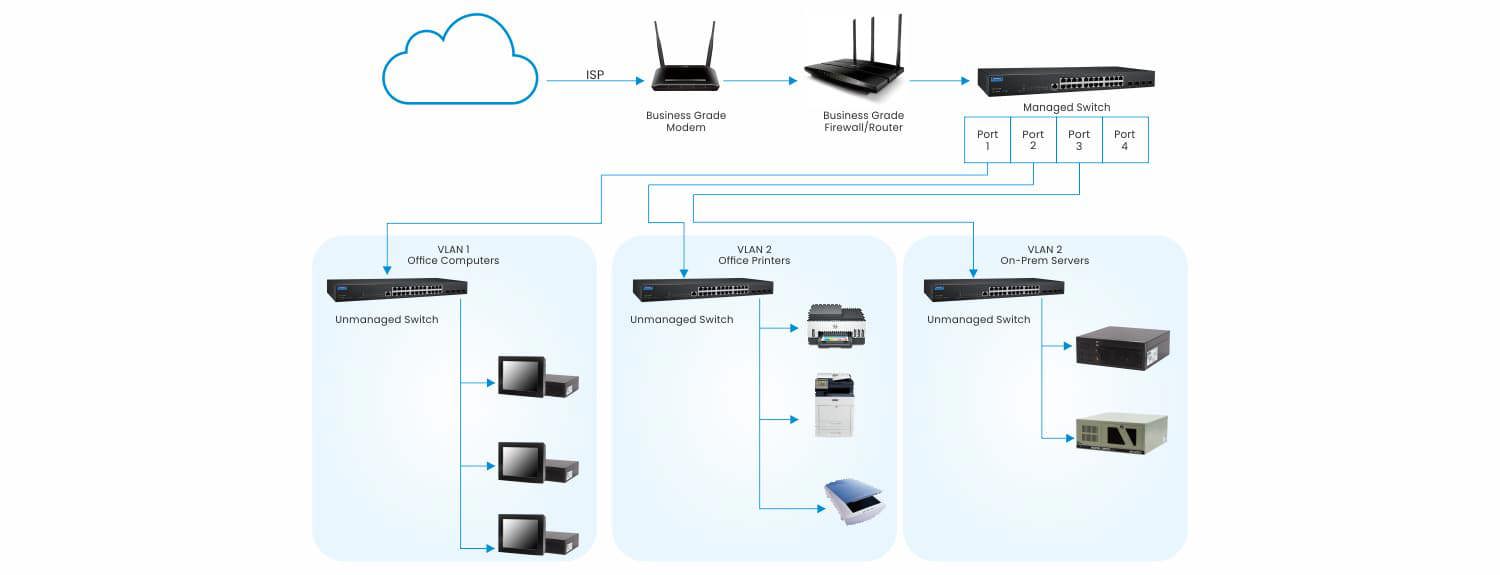
Unmanaged switches can be plugged into the network immediately and get the netwrok running. There is no need for any configuration.
A managed switch shall be configured into a network to prioritize channels ensuring optimum performance where it is needed. Also managed switches are less likely to falter and allows for remote troubleshooting making it easier to check for any issues impacting performance.
Network administrators maintain both managed and unmanaged switches. With managed switches the network administrators can configure managed switches to handle the trafficmore efficiently.
Unmanaged switches have very basic security.
Managed switches have the ability to detect active threats, protect data and control the ports. The level of security can include features like network communication encryption, access control list and VLANs that allow limited access to networks.
Unmanaged switches are cheaper and a easy choice for simpler networks.
Managed switches command higher cost which depends on the features such as security and access controls, in addition to switch configuration abilities.

Unmanaged switches are suitable for simple, uncomplicated networks with a few connected devices.
Widespread and complex networks require reliability, control and security. Such networks require managed switches that provide the required security and control.Generally such networks are found in enterprise-level businesses, government agencies, universities and healthcare organizations.
Sometimes small networks also deal with a lot of highly sensitive data, asking for reliability and high security. In such applications, the network administrator will have to choose managed switches.
Networks requiring temporary or limited degree access to some connected devices, from time to time, should choose for managed switches. In such cases, VLAN function of managed switches is useful to ensure flexibility and security.
The choice between a managed switch and an unmanaged switch ultimately depends on the specific needs and requirements of your network. In a nutshell, if you have a small network with basic connectivity needs and a limited budget, an unmanaged switch may suffice. But if you have a larger network, require advanced features, and value control and optimization capabilities, a managed switch is the way to go. Assess your network requirements, budget, and technical expertise to make an informed decision on which type of switch is best suited for your specific requirements.
LUBI Electronics is a leading company in India, exhibiting expertise in the automation, solar, and control panel industry.
We offer Advantech and Moxa products and solutions for Industrial Computing & Networking, Intelligent Transportation Systems, Data Acquisition, SCADA and IIOT.
For more information on our offerings, please reach out to us at lubi@lubielectronics.com.

As the industrial world shifts toward Industry 4.0, key technologies pushing the boundaries of IT and OT environments include AIoT, digital twinning, and digital convergence.

Recent global events have made digitalization an urgent and compelling goal. Most companies, regardless of industry, are beginning to realize that digital transformation is imperative to avoid falling behind and becoming uncompetitive.

To achieve operational resilience, more and more businesses are focusing on transitioning to digitalized operations.